Perspectives
Etched: The Inference System for the AI Economy
August 18, 2026

By
Mamoon HamidInference is becoming the most important infrastructure market in AI. As models reason longer and agents take on more work, the economics will increasingly come down to how many tokens a system can produce per dollar and per watt.
Etched is building for that market, and what the team has accomplished in three years is nothing short of extraordinary.
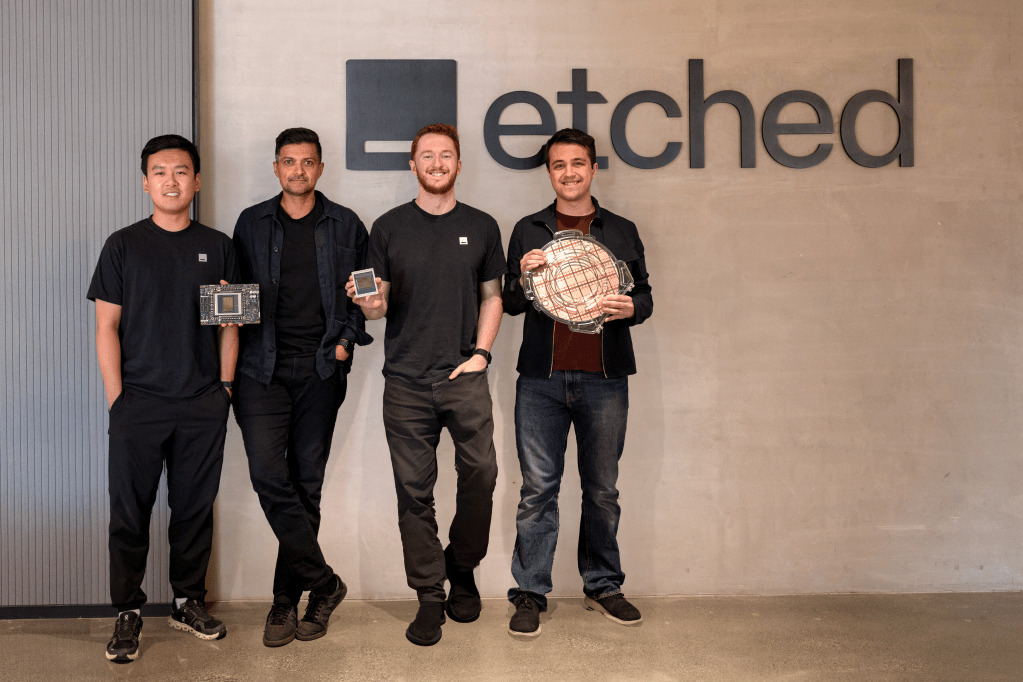
What started as three Harvard dropouts with a contrarian idea has turned into a serious contender in inference compute. Gavin Uberti, Rob Wachen, and Chris Zhu started the company in 2022 with a bet that transformers would become the dominant architecture for AI and that purpose-built hardware could run them more efficiently. As the market evolved, that thesis expanded to inference more broadly.
Today, Etched has working silicon and systems, and more than $1 billion in signed customer contracts. The company has designed the full rack-scale system, including networking, switching, cooling, power, and software, giving it control over the entire stack and the ability to optimize around two of the metrics that matter most: tokens per dollar and tokens per watt.
Last month, Jane Street became the first customer to take delivery of an Etched rack and is already running production workloads. Jane Street operates some of the most technically demanding infrastructure in financial markets, where performance, reliability, and latency are fundamental to the business. Going from first silicon to production workloads in an environment like that is an important proof point for how quickly Etched is moving.
The architecture behind that progress is also what first drew me into the technical details of what Etched was building. I’ve spent a lot of time with the team over the past few months, and we quickly bonded over an aspect of their technical approach that took me back to my thesis work as an electrical engineering student: operating transistors at much lower voltages to dramatically reduce power consumption. Dynamic power scales roughly with the square of voltage, so cutting voltage in half can reduce that component of power by roughly 4x.
Etched also brought back memories of the beginning of my career. I started in 1997 as an engineer at Xilinx in San Jose, where there was a palpable sense of excitement that our silicon was helping to power the networking infrastructure of the Internet as it was being built. I felt something similar the first time I visited Etched’s headquarters, also in San Jose—except the opportunity in front of Etched feels orders of magnitude larger. Many employees have moved into apartments across the street from the office, and on a recent Friday afternoon the place was still buzzing well into the evening. There is an intensity and sense of purpose that feels more like an early software company than a semiconductor company—even as Etched takes on one of the hardest engineering and manufacturing challenges in technology.
Rob and I happened to overlap in Paris for the RAISE Summit. We spent part of an afternoon squeezed into small coffee shops talking with potential customers. What struck me was how naturally he could move from chip architecture and networking to customer requirements and the operational details of deploying systems in production. That breadth says a lot about the company Etched is becoming. Building a great chip is difficult. Building the system around it—and getting that system into customers’ hands—is an entirely different challenge.
Gavin, Rob, and Chris have assembled a team capable of doing both. Etched now includes engineers who helped bring Google’s TPUs, Nvidia’s GB300 systems, and Meta’s MTIA accelerators into production, with experience spanning silicon, software, systems, manufacturing, and deployment.
That depth of experience is showing up in the speed of execution. Semiconductor companies are normally built generation by generation, with each cycle taking years. Etched has compressed an extraordinary amount into just three years: from a contrarian bet on inference to working silicon, a complete inference system, significant contracted demand, and production workloads.
That pace matters because the inference market is still taking shape, and competition will only intensify. The AI economy is going to require an enormous amount of inference compute, and Etched has a chance to become one of its most important infrastructure suppliers.
We’re excited to partner with Gavin, Rob, Chris, and the entire Etched team for what’s to come.